

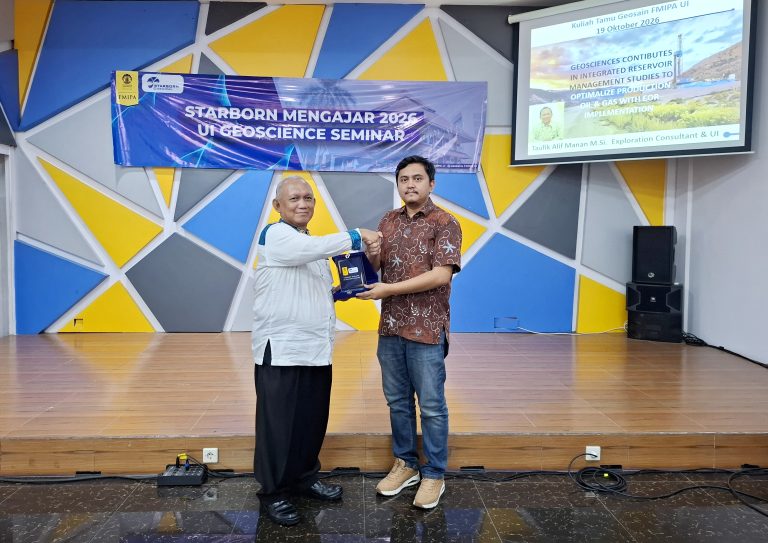
Depok, 26 October 2026 – The Faculty of Mathematics and Natural Sciences, Universitas Indonesia (FMIPA UI), welcomed its alumnus and oil and gas industry practitioner, Ir. Taufik Alif Manan, M.Si., to share insights into the contribution of geosciences to integrated reservoir studies. The discussion covered the application of Enhanced Oil Recovery (EOR) to optimize oil and gas production. Through this forum, students gained an overview of how geological and geophysical knowledge is applied in the upstream oil and gas industry, from exploration to the implementation of technologies designed to enhance oil recovery, particularly in fields that have entered the production decline phase.
The event, entitled “Geosciences Contribute to Integrated Reservoir Management Studies to Optimize Oil and Gas Production through EOR Implementation,” was part of the Universitas Indonesia Geoscience Seminar (UIGS) x Starborn Mengajar 2026 series. It was held on Monday (19 October 2026) at the Prof. Dr. G.A. Siwabessy Auditorium, FMIPA UI, and moderated by Ayunda Aulia Valencia, S.T., M.T.
Ir. Taufik Alif Manan, M.Si., is an Exploration Consultant at PT PetroRaya Resources and an adjunct lecturer in the Geology and Geophysics Study Programs at FMIPA UI. He is also an alumnus of the Department of Physics, FMIPA UI. With more than 34 years of experience in the oil and gas industry, he has worked across various fields, including new ventures, exploration, subsurface, development, and operations of both conventional and unconventional oil and gas projects. More than 16 years of his career have been spent in managerial positions. He has also been involved in various international projects in Oman, Cambodia, and Malaysia.
In his presentation, Taufik explained that success in the upstream oil and gas sector relies on three interconnected stages. Geosciences play a role in discovering reserves, reservoir studies provide an understanding of subsurface accumulations, while production and EOR technologies help bring the remaining oil to the surface.
“Exploration concepts are essentially geological models or working hypotheses used to determine where hydrocarbons may be located. There is a saying, ‘oil is found in the mind of man’. This is particularly relevant in frontierareas, where we need new concepts to discover potential reserves,” Taufik said.
He also explained that oil and gas operations involve a lengthy cycle, beginning with exploration and development planning, followed by field development, a stable production period (plateau), and eventually the production decline phase.
“From exploration to the Plan of Development , the process can take one to eight years. This is followed by field development, the plateauperiod, and then the decline and production enhancement phases, which can last between five and 25 years. Therefore, secondary and tertiary recovery stages must be prepared early, starting with advanced seismic processing, 3D seismic acquisition, well data updates, and modeling, through to pilot projects,” he explained.
To illustrate how these concepts are applied in practice, Taufik shared several industry experiences and case studies with the students. One example was the reinterpretation of the Semai Area, which led to new insights into its subsurface geological conditions. New seismic data revealed deeper geological layers and confirmed the possibility of Jurassic-aged sediments. According to Taufik, these findings contributed to the area’s successful award in the 2008 regular bidding round, with a signature bonus of US$40 million, which at the time was the highest recorded in Indonesia.
Beyond exploration, the discussion also highlighted the importance of reservoir management as an integrated process to maximize reservoir recovery and profitability throughout its production life, with the primary objective of maximizing Net Present Value (NPV). This process involves reservoir characterization, production optimization, well management, reservoir simulation, economic evaluation, and production performance monitoring.
“The key to reservoir management lies in integrating geosciences with engineering, as well as combining exploration technologies with field development. Geophysics, geology, petrophysics, reservoir engineering, and production engineering must all work together within an integrated framework,” Taufik stated.
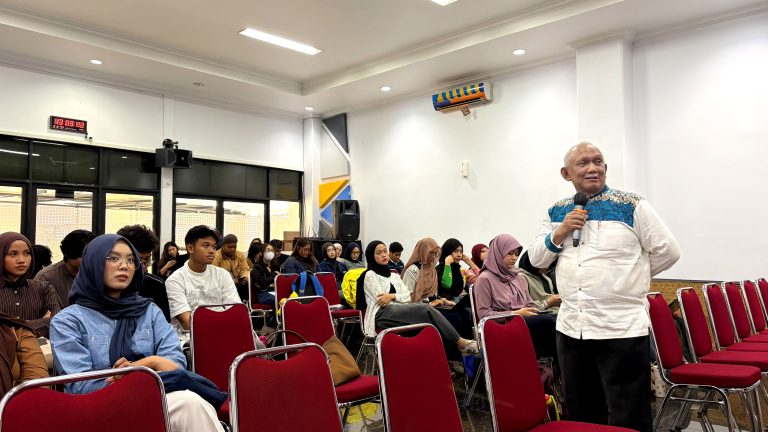
Taufik emphasized that the integration of geosciences and engineering is essential for making field development decisions. Subsurface data and interpretation results must be linked to production strategies and economic considerations to ensure that every technological decision delivers optimal results.
Furthermore, he outlined the three main stages of oil recovery: primary recovery, which relies on the reservoirnatural energy; secondary recovery, also known as Improved Oil Recovery (IOR); and tertiary recovery through Enhanced Oil Recovery (EOR). In the EOR stage, specific forms of energy or chemicals are injected into the reservoir to increase the amount of oil that can be produced. Through the application of these technologies, the oil recovery factor, which generally stands at around 30%, has the potential to increase to approximately 40–60%, depending on field characteristics and the technologies employed.
Taufik described Indonesia as a pioneer and one of the largest countries in EOR implementation, with its application beginning in 1967 at the Duri Field, Rokan Block. Several EOR projects have since been developed across various regions, including Sumatra, Kalimantan, and West Java. The potential for applying these technologies is estimated at 950 million stock tank barrels(MMSTB) in 12 location.
In addition to discussing the oil and gas industry, the discussion and Q&A session also explored opportunities for FMIPA UI graduates to apply their geological and geophysical expertise in supporting the energy transition, particularly through Carbon Capture, Utilization, and Storage (CCUS). According to Taufik, this rapidly developing field continues to require geological expertise, especially in understanding rock characteristics and subsurface conditions. He also emphasized the importance of students’ ability to integrate historical data, mapping, and field observations to produce comprehensive geological interpretations.
Concluding his presentation, Taufik stressed that oil and gas field management requires the integration of various scientific disciplines and technologies, ranging from exploration and reservoir studies to production enhancement strategies through EOR. He encouraged students to continuously develop their skills, broaden their knowledge, and embrace forward-thinking approaches to meet the challenges of the energy industry.
Through this seminar, FMIPA UI students are expected to gain a better understanding of how geological and geophysical knowledge is applied in industry, broaden their perspectives on developments in energy technologies, and recognize opportunities to contribute their expertise, both to the oil and gas sector and to the future energy transition.